Pineal Gland: Seat of the Soul
Egyptians, Hindus, Buddhists, gnostic Christians, and Hellenistic anatomists never met, yet each named the same gland the seat of inner vision. Science agrees.
“The light of the body is the eye: if therefore thine eye be single, thy whole body shall be full of light.” — Matthew 6:22 (KJV)
Open any serious text on third-eye traditions and the same problem keeps surfacing. Cultures that never met, separated by thousands of years and the better part of a continent, all pointed at one specific spot on the human skull, all named it the same thing in their own languages, and all said the same things about it.
The Egyptians drew it on tomb walls three thousand years before Christ. In the Upanishads, around 800 BCE, it shows up codified as the ajna center. The Buddhists put it on every depiction of the Buddha, where it is still called the urna today. The gnostic Christians encoded it in the Gospel of Thomas. Galen and Herophilus, working in the Hellenistic medical tradition, identified it as the seat of the rational soul. Descartes, writing in 1641, called it the seat of the soul outright, was mocked for the next four centuries, and was not actually wrong about which structure he was pointing at.
Every tradition gave it a name in its own language. Third eye. Single eye. Eye of Horus. Ajna. Deva-netra. Each described the same set of properties. It perceives light when the physical eyes are closed. It is the organ through which the divine is received. It calcifies and seals under neglect. It can be reopened through specific practices.
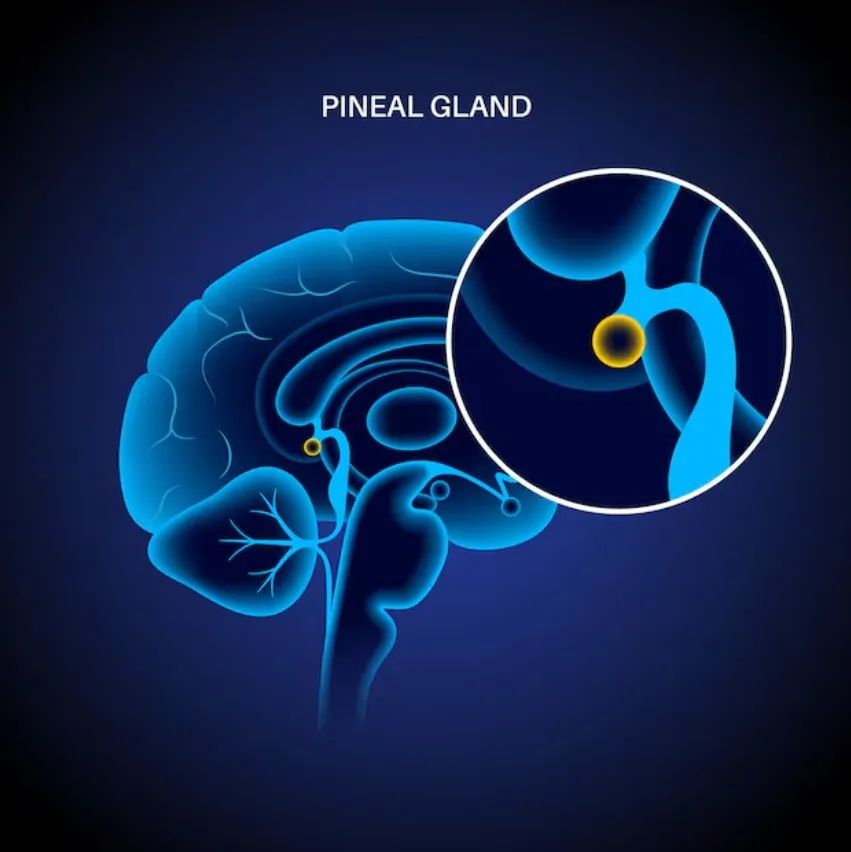
In the middle of the human head, exactly at the spot these traditions identified, sits a small endocrine gland called the pineal. Modern neuroscience has confirmed it is genuinely photosensitive, that it produces the body’s master photoperiodic hormone, that it appears to synthesize the molecule most closely associated with mystical experience, and that it calcifies progressively over the modern lifespan at rates the contemplative literature would have predicted from its own descriptions of what happens to a neglected third eye.
The claim here is that this is not coincidence. Five civilizations identified the same physical structure independently, gave it the same properties, and prescribed the same kinds of practices for opening it. The science has caught up to most of the structural anatomy and a meaningful slice of the function. The mystical interpretations remain interpretive. The location is the location.
This is what they were pointing at.
The Egyptian Eye
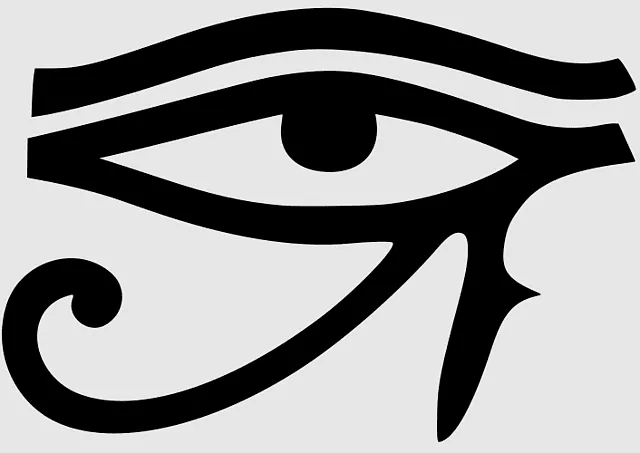
The Eye of Horus, the wedjat, is the most recognizable image to come out of dynastic Egypt. It was drawn on tomb walls, stamped on amulets, carved into temple lintels, painted on the prows of funerary boats. The standard Egyptological reading is that it represents the moon (Horus’s left eye, lost in the battle with Set, restored by Thoth) and serves as a symbol of protection, royal power, and the restoration of what was broken. That reading is correct as far as it goes. It is also incomplete.
Look at the wedjat carefully. The shape on the right side, the curling spiral that descends from the inner corner, is not arbitrary ornament. To anyone who has looked at a brain in cross-section it reads as a stylized rendering of the thalamus and the structures clustered around it, the pineal, the thalamic mass, the hypothalamus, the connecting peduncles. The Egyptians embalmed the dead. They removed brains through the nose with a hooked instrument. They had opportunity. The correspondence between the wedjat’s curl and the cross-sectional anatomy is too clean to write off entirely as projection, and the tradition itself never claimed the symbol was decorative.
The Egyptians worked with two paired eye symbols. Horus’s left eye was the moon, restored. His right eye, the Eye of Ra, was the sun. In the temple traditions the two eyes paired in iconography were ultimately one eye, split into apparent duality at the surface of the visible world. The two physical eyes bracket a third. Bill Donahue makes the same point reading the crucifixion (Hidden Meanings). Two thieves at the cross. Two eyes of the head. The single eye between them.
The pharaoh’s headdress carries the operational claim. The uraeus, the cobra rising from the forehead, sits at precisely the spot where Hindu iconography paints the bindi and Buddhist iconography places the urna. The cobra rises from the third eye. The pharaoh, in this reading, is not just a king. He is a depiction of the human in whom the central eye has opened.
The Hindu and Buddhist Layer
In Hindu yogic anatomy the ajna chakra sits between and slightly above the eyebrows. Ajna means command or perceive. It is the sixth of seven chakras, the penultimate stop before sahasrara at the crown. Hindu iconography places the bindi at this exact location, originally a religious mark indicating recognition of the inner eye, only later cosmetic. The Upanishads describe meditation practices specifically aimed at activating this center. When the activated yogi is depicted, the third eye is open and frequently emitting flame or light.
Buddhist iconography is more explicit. Every depiction of the Buddha shows the urna, a small dot, jewel, or curl of hair at the precise center of the forehead. The urna is one of the thirty-two physical marks of a Buddha. The scriptural explanation is that it represents the wisdom-eye through which the Buddha sees reality directly, unmediated by the physical senses. Tibetan tantric practice includes specific meditations aimed at activating this center, and the tukdam tradition, the post-death meditative state in which advanced practitioners are reported to remain conscious for days or weeks after clinical death, has been observed to involve unusual conditions around the pineal region.
The Hindu and Buddhist traditions agree on the location, on the function, and on the practices used to access it. They agree, too, on the consequence of activation: direct perception of reality unmediated by the senses. The yogic and Buddhist literatures treat this not as metaphor but as a structure that, under the right conditions, produces a specific kind of perceptual experience the rest of life does not produce.
The Christian Esoteric Layer
The mainstream Christian tradition lost most of this. The esoteric layer kept it.
The key verse is Matthew 6:22: “The light of the body is the eye: if therefore thine eye be single, thy whole body shall be full of light.” The Greek word translated single is haplous, meaning unified, whole, undivided. Donahue’s reading is that the verse names the pineal directly. The body has two physical eyes and one inner eye. The single eye is the third one. When it becomes haplous, the body fills with light.
Genesis 32:30 supplies the second key. Jacob wrestles with the angel through the night and at dawn names the place Peniel, declaring “I have seen God face to face, and my life is preserved.” Peniel. Pineal. The phonetic overlap is contested, academic philology does not endorse the etymology, but the structural point is independent of the etymology. Jacob has the divine encounter at a location he names, and the location is named as the place where God is seen. In the comparative literature the placement of a divine encounter at a specific named location on the head is exactly the signature you would look for if you wanted to identify a third-eye experience under another vocabulary. Whether or not Peniel derives from pineal linguistically, the two passages are making the same structural claim.
The Gospel of Thomas, recovered from Nag Hammadi in 1945, makes the same point with less hedging. Logion 22 reads as coded instruction: “When you make the two one… when you make eyes in place of an eye… then you will enter the kingdom.” Replace the two physical eyes with the single inner eye and the kingdom opens. The Coptic Christian tradition that produced the Gospel of Thomas was suppressed by the institutional church in the fourth century. The texts were buried in the Egyptian desert and not recovered until the twentieth. What was buried with them was a Christian tradition that still understood what the verse in Matthew was talking about.
The pineal vocabulary survived in marginal Christian traditions. The Eastern Orthodox hesychasts spoke of the light of Tabor, the uncreated light seen by the apostles at the Transfiguration and seen, also, by the contemplative monk in deep prayer. Hesychast literature describes the perception of this light as a physiological event located in the head, accessed through specific breathing and posture practice. Western Catholic mystics, Hildegard of Bingen, Meister Eckhart, the author of The Cloud of Unknowing, described the same phenomenon under different names. The names changed between traditions. The location of the phenomenon did not. For the longer case that the rest of the Christian scripture is coded instruction for the same anatomy, see The Real Bible.
What The Neuroscience Actually Says
Take the symbolism away and look at the established science. The list is shorter than the comparative tradition suggests, and stranger than a standard endocrinology textbook tends to admit.
It is genuinely photosensitive. In birds, reptiles, amphibians, and many fish, the pineal is a literal third eye, a photosensitive organ that responds directly to light passing through thin cranial bone above it. The lamprey eel has a fully developed pineal eye complete with lens and retinal cells. In mammals the photosensitivity is mediated indirectly, through the retinohypothalamic tract, but the function as the body’s primary photoperiodic regulator (the structure that translates light information into hormonal signaling) is established. It is the only unpaired structure in the brain. It sits exactly on the midline, between the two hemispheres, in the location every contemplative tradition independently identified. The broader claim that the body is observation-sensitive at every measured scale is The Observer Effect: Attention Becomes Anatomy.
It produces melatonin. Melatonin is the master regulator of circadian rhythm and one of the most potent antioxidants the body produces. Melatonin synthesis peaks in darkness between 2 and 3 AM, and is suppressed by light, especially blue light. The contemplative claim that meditation in pre-dawn darkness produces specific perceptual states has at least one biochemical mechanism to hang on. That window is exactly when the gland is most active.
It probably produces DMT. N,N-dimethyltryptamine is the molecule most associated with mystical and near-death experiences. Rick Strassman’s research at the University of New Mexico in the 1990s, controversial then and partially confirmed since, suggested the pineal as the likely site of endogenous DMT synthesis. A 2013 paper from Jimo Borjigin’s group at Michigan confirmed DMT presence in the pineal of living rats. The full picture is contested. DMT appears to be produced in multiple tissues, not exclusively the pineal. But the pineal is one production site, and the molecule is in the gland identified by every mystical tradition as the seat of mystical experience. Strassman’s working hypothesis was that pineal DMT production at the moment of death, or under specific contemplative conditions, is the proximate biochemical cause of the mystical experience. Not proven. Also not implausible.
It calcifies. This is the part most people don’t know. The pineal calcifies progressively over the human lifespan, accumulating calcium phosphate and hydroxyapatite visible on MRI. By age sixty, sixty to eighty percent of pineal glands show significant calcification. Fluoride exposure accelerates the process, with fluoride concentrating in pineal tissue at higher levels than anywhere else in the body and forming calcium fluoride deposits that interfere with function. Industrial-era populations show calcification rates the paleopathological data does not document at the same scale in pre-industrial populations. Whether the proximate cause is fluoride, broader lifestyle, or both, is debated. The calcification is established.
A calcified pineal is, in the contemplative vocabulary, a sealed eye. The eye that no longer opens. And the practices the traditions prescribed for keeping it open, meditation, fasting, darkness, silence, gaze-release, breath discipline, are the same practices modern research has begun to correlate with reduced pineal calcification, higher melatonin production, and (under fasting) the autophagy that clears the kind of cellular debris that contributes to calcification in the first place. The traditions and the science are describing the same thing in different vocabularies.
Why The Intersection Matters
Five civilizations, working in isolation, identified the same exact physical structure as the organ of inner vision and assigned it the same set of properties. Modern neuroscience confirms that the structure exists at the location identified, that it is photosensitive, that it is the body’s primary light-derived hormonal regulator, and that it is the probable site of the molecule most associated with mystical experience. It calcifies in the modern population at the rates the traditions would have predicted, given their descriptions of the neglected eye.
The Egyptians, the Hindus, the Buddhists, the gnostic Christians, the Hellenistic anatomists, all pointed at the same spot in the human head. The spot has a gland in it. The gland does roughly what the traditions said it would.
The practices ancient cultures developed to keep the gland active, meditation, fasting, darkness, silence, ocular release, breath work, sustained attention to the third-eye region, are practices modern research has begun to confirm have measurable effects on the gland’s function and on the practitioner’s neurobiology. For the deepest of those tools — the one that engineers, biochemically, the exact quietness the gland needs to operate — see Fasting and Manifestation.
The operational implication is straightforward. The pineal is a physical structure that does specific things under specific conditions. The conditions the contemplative literature prescribes for opening it overlap with surprising precision with the conditions modern research has identified as supportive of its function. Fasting cycles. Pre-dawn quiet. Soft-gaze instruction. The dark-room hypnopompic window. All of these can be read as practices that, among other things, support one specific gland in one specific spot in the head.
The Egyptians knew. So did the Hindus, the Buddhists, the gnostic Christians, and (in his way) Descartes, who was mocked for the position for four centuries and was not wrong about which structure he was pointing at. The single eye is real, it sits in the location every tradition said it sits, and the practices that open it are the practices the contemplative literature already prescribed. Five civilizations made the same bet, drawn at the level of one specific gland.
Sources
Comparative tradition:
- The Egyptian Book of the Dead (Wallis Budge translation; cf. R. T. Rundle Clark, Myth and Symbol in Ancient Egypt, 1959)
- The Upanishads (Eknath Easwaran translation recommended)
- Edward Conze, Buddhist Thought in India (1962)
- The Gospel of Thomas (Marvin Meyer translation; Nag Hammadi codices)
- The Philokalia (Palmer/Sherrard/Ware translation), hesychast literature
- Bill Donahue, Hidden Meanings lecture series
Neuroscience and medicine:
- Rick Strassman, DMT: The Spirit Molecule (2001)
- Jimo Borjigin et al., “LC/MS/MS analysis of N,N-dimethyltryptamine in rat brain” (Biomedical Chromatography, 2013)
- Jennifer Luke, “Fluoride deposition in the aged human pineal gland” (Caries Research, 2001)
- Standard endocrinology and neuroanatomy on pineal physiology
Philosophical:
- René Descartes, The Passions of the Soul (1649)
- Galen, On the Usefulness of the Parts of the Body (second century CE)
Scripture (KJV): Genesis 32:30. Matthew 6:22. Gospel of Thomas logion 22.
Caveats stand. The pineal’s photosensitivity, its role in melatonin production, and its calcification are established science. The DMT-production hypothesis is at the frontier and partially confirmed. The mystical and contemplative claims are interpretive and contested. The cross-cultural convergence is real and unexplained. Take nothing literally, subject everything to inquiry, keep what aligns with direct experience, and discard the rest.