I AM: The Most Leveraged Words You Speak
Across Hebrew, Greek, Sanskrit, Arabic, and Latin, the divine name is the same: I AM. Whatever predicate you finish it with is an act of self-creation.
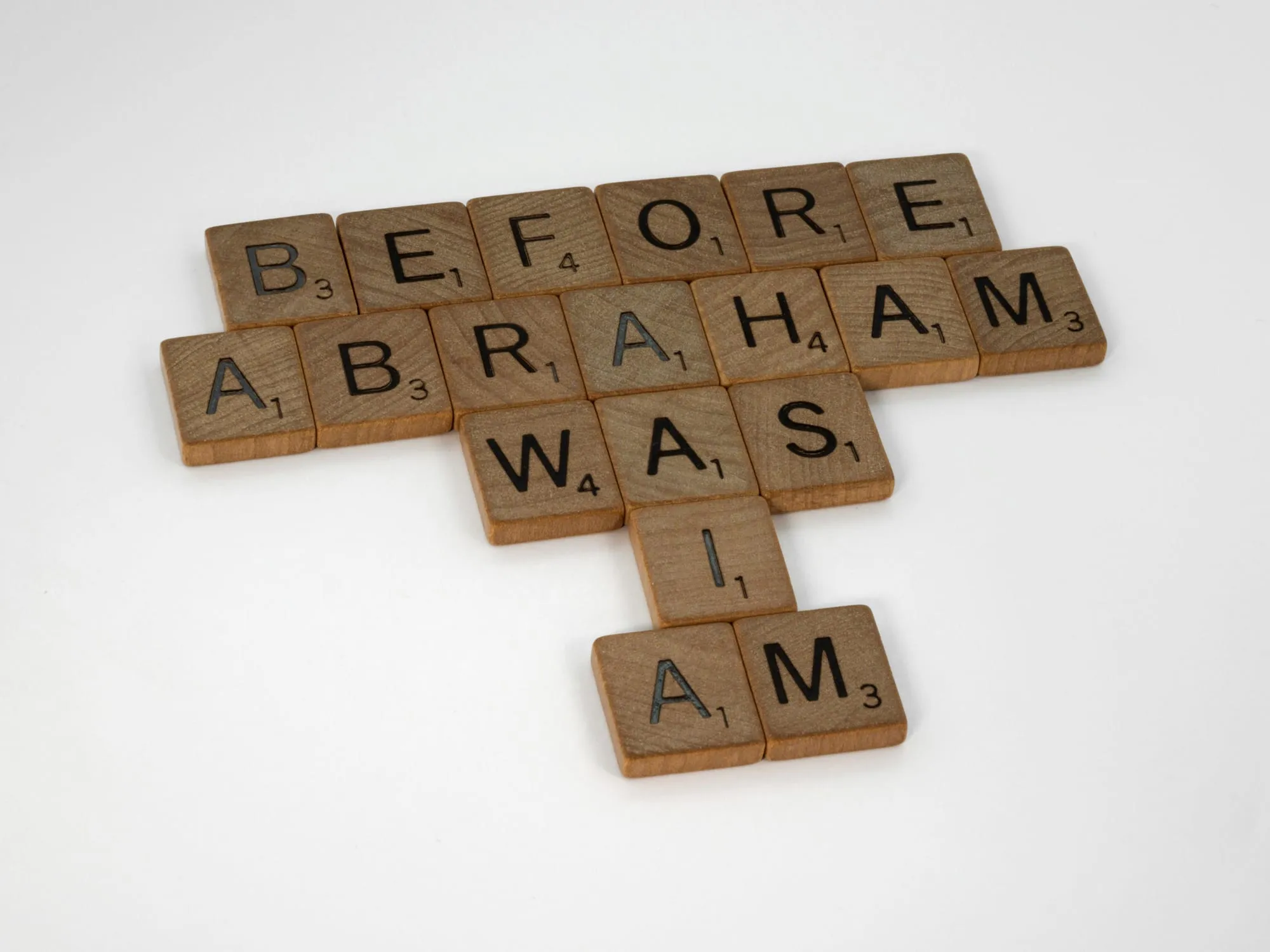
“And God said unto Moses, I AM THAT I AM: and he said, Thus shalt thou say unto the children of Israel, I AM hath sent me unto you.” — Exodus 3:14 (KJV)
“Verily, verily, I say unto you, Before Abraham was, I am.” — John 8:58 (KJV)
There is a phrase you finish a hundred times a day without thinking about it. I am tired. I am late. I am bad with money. I am not the kind of person who… Each completion is treated as a casual observation. None of them is a casual observation. Every I am ___ statement is an act of self-creation that the body, the subconscious, and the field of circumstance respond to as instruction.
The reason the phrase carries this much weight is that it has carried that weight in every contemplative tradition that ever took consciousness seriously. The name God gave himself in Exodus is I AM. The name Jesus claimed for himself in John’s gospel is the same. Neville Goddard built his entire manifestation system on it. The Hindu tradition has been saying Aham Brahmasmi, I am Brahman, for three thousand years. The Sufis say Ana al-Haqq, I am the Truth. The Christian mystics from Eckhart onward built their theology on the immediate identification with the divine I. The convergence across Hebrew, Greek, Sanskrit, Arabic, and Latin is the foundational signal that whatever the phrase is pointing at is real, is operative, and is available to anyone willing to take it seriously. (For the broader case that eight traditions arrived at the same operational claim, see The Convergence.)
Most people are using the most powerful manifestation tool in their possession to install limitations they did not consciously choose. This piece is the case for taking the phrase back.
The Burning Bush
The scriptural anchor is Exodus 3:14, the moment at the burning bush when Moses asks God for his name. The answer in the King James is famous: And God said unto Moses, I AM THAT I AM: and he said, Thus shalt thou say unto the children of Israel, I AM hath sent me unto you. The Hebrew is Ehyeh asher ehyeh. The English translation flattens it. The Hebrew is grammatically unusual in ways that almost no English rendering preserves.
Ehyeh is the first-person form of the Hebrew verb hayah, to be. Asher is a relative pronoun. Ehyeh again. I AM that I AM. But the Hebrew verb form is not tense-locked the way English is. Ehyeh could equally be translated I shall be, I am becoming, I will be what I will be, I am the one who is. The phrase resists fixing into a single moment of time because the verb is making a point about being itself rather than about a specific moment of being. The name God gives himself is therefore not a name in the way Moses’s name is a name. It is the experience of being, formalized into a self-reference. My name is the act of being itself. I am the being that is. Anything that is participates in me.
The Tetragrammaton, YHWH (יהוה), the four-letter Hebrew name of God that appears more than 6,800 times in the Hebrew Bible, is derived from the same root hayah. Grammatically, the Tetragrammaton is a third-person form of ehyeh. He is. He causes to be. He who is. The two names are the same divine reality from different grammatical persons. The first person is I AM. The third person is He is. The God who speaks from the bush is identifying himself, in first person, as the same being whom Israel will name in third person for the next three thousand years. The divine name is the verb to be, fully conjugated.
This means every subsequent appearance of I AM the LORD in the Hebrew Bible is the divine name echoing the Burning Bush. I am the LORD thy God which brought thee out of the land of Egypt (Exodus 20:2). I am the LORD, and there is none else (Isaiah 45:5). The phrase is not a name in the conventional sense. The phrase is the divine name, and the divine name is the experience of being.
Jesus and “I AM”
The gospel of John reads, on close inspection, as a sustained argument that Jesus is the divine name in human form. John repeatedly puts the bare phrase I am, in Greek ego eimi, into Jesus’s mouth in contexts that are scripturally and grammatically loaded.
The most famous occurrence is John 8:58. Jesus has been in dispute with religious authorities about his identity. He concludes the argument with: Verily, verily, I say unto you, Before Abraham was, I am. The Greek is prin Abraam genesthai ego eimi. Notice the grammar. Before Abraham was is past tense. I am is present tense. The two clauses cannot be reconciled within normal grammar. The phrasing is not Jesus claiming to predate Abraham. It is Jesus claiming that he is the timeless I AM that the Burning Bush named.
The audience understood exactly what he was claiming. The very next verse: Then took they up stones to cast at him (John 8:59). Jesus has just committed, in their hearing, the capital offense of claiming the divine name as his own.
John builds the entire gospel around this. Seven I AM statements with predicates structure the book:
- I am the bread of life (John 6:35)
- I am the light of the world (John 8:12)
- I am the door (John 10:9)
- I am the good shepherd (John 10:11)
- I am the resurrection, and the life (John 11:25)
- I am the way, the truth, and the life (John 14:6)
- I am the true vine (John 15:1)
Each statement is structured the same way. Ego eimi ___. The divine name plus a predicate. The structural claim of the gospel is that the bread of life, the light of the world, the resurrection, the truth, and the vine are all predicates of the I AM. Whatever you complete the divine name with becomes an aspect of the divine name. The gospel writer is doing two things at once. He is teaching that Jesus is the divine I AM, and he is teaching the reader how the phrase works.
Donahue’s reading takes this further. He argues the entire seven-statement structure of John is a meditation manual encoded in narrative. Each I AM ___ names an aspect of the consciousness the meditator is to recognize as his own. The reader who has been told that the gospel is a history book misses the second teaching entirely. For the longer case that the rest of scripture is encoded the same way, see The Real Bible.
Neville Goddard’s Central Teaching
Neville Goddard read all of this with utter literalism in one direction and complete metaphoric flexibility in another. He took the divine name as literally the practitioner’s own self-awareness. He took every story in the Bible as metaphor for the practitioner’s inner life.
His core claim, repeated across forty years of lectures: the only God you will ever find is your own awareness of being. I AM is the divine name because I AM is the irreducible experience of being conscious. When you say I am, with attention and feeling, you are using the divine name. What you finish it with is the divine creative power applied to whatever predicate you choose.
From The Power of Awareness (1952): The awareness of being is the only reality. The conditions and circumstances of life are nothing in themselves; they are made what they are only by your assumption that they are so. From Feeling Is the Secret (1944): Self-observation will reveal the existence of more than one self… but only one is the real self. The real self is the I AM. From his 1948 lecture titled “I AM”: Whatever you are conscious of being, you can be. The state of consciousness, called I AM, is the only thing that creates.
The operational instruction follows directly. Every I am ___ statement is an act of creation. The phrase I am tired is not a description of a state. It is an instruction. The phrase I am bad with money is not a confession. It is an installation. The phrase I am the kind of person who… is not character self-knowledge. It is the divine name being used to manufacture exactly what comes after it.
Neville’s central practice, the assumption of the wish fulfilled, is the conscious use of the divine name. I am wealthy. I am healthy. I am the one who has the partner. I am the kind of person who… The point of holding the assumed state is not to convince yourself of something untrue. The point is that the divine name applied to a predicate is the mechanism by which reality is generated. The person who has noticed this gets to choose his predicates. The person who has not noticed it has been choosing them on default since childhood, mostly out of fear and self-criticism, and is wondering why his life looks the way it looks. The contemporary mass-culture instance of this is Lucky Girl Syndrome — eighty million people running I am lucky without knowing they are using the divine name.
The Hindu Layer
The Hindu tradition arrived at the same conclusion working from completely different premises, three thousand years before Neville.
Aham Brahmasmi. I am Brahman. This is one of the four Mahāvākyas, Great Sayings, of the Upanishads, and it is the most direct statement in Vedic literature of what the Burning Bush was pointing at. The phrase appears in the Bṛhadāraṇyaka Upaniṣad (c. 800 BCE). Brahman is the unchanging, infinite, immanent ground of being. The aham, the I that is doing the saying, is being identified with that ground.
The other three Great Sayings repeat the claim from different angles. Tat tvam asi, Thou art That, from the Chāndogya Upaniṣad: the thou being addressed is identical to the That which is the universal ground. Prajñānam Brahma, Consciousness is Brahman: the conscious awareness in you is the same conscious awareness that constitutes ultimate reality. Ayam Ātmā Brahma, This Self is Brahman.
Four sayings. One claim. The I that you are is identical to the divine ground. The Hindu vocabulary calls this Sat-Chit-Ananda, Being, Consciousness, Bliss, three faces of one ultimate reality, in which the practitioner’s I AM participates by structural identity. The same Aham Brahmasmi runs straight through the Bhagavad Gita, where it lands, almost verb for verb, on Christ’s I and the Father are one; the full verse-by-verse case is Krishna and Christ.
The Māṇḍūkya Upaniṣad takes the analysis further. It identifies four states of consciousness: waking (jāgrat), dreaming (svapna), deep dreamless sleep (suṣupti), and a fourth state called Turīya, pure awareness. The fourth state is what remains when content is stripped from consciousness. It is the pure I AM without any predicate. The Māṇḍūkya identifies this with Brahman directly. The unconditioned, predicate-less I AM is the divine name.
The Sufi tradition adds another witness. The ninth-century Persian mystic Mansur al-Hallaj declared Ana al-Haqq, I am the Truth, and was executed for it in 922 CE. The Truth is one of the ninety-nine names of God in Islam. Hallaj was making the same claim Jesus made, in a different language, eight centuries later, and the authorities killed him for the same reason.
The Christian Mystical Tradition
The mainstream Western Christian tradition spent most of two thousand years backing away from the implications of John 8:58, insisting that Jesus’s identification with the I AM was a one-time event reserved for the second person of the Trinity and not available to the rank-and-file Christian. The Christian mystical tradition refused this restriction and was repeatedly censured for it.
Meister Eckhart, the fourteenth-century Dominican preacher, taught explicitly that the practitioner’s deepest self is identical to the divine I AM. His sermons returned again and again to a phrase he called the spark of the soul (scintilla animae), the point within the practitioner that is uncreated and uncreatable, where the practitioner and God meet without distinction. His German sermon 52 contains the line that defines the tradition: The eye through which I see God is the same eye through which God sees me. He was charged with heresy in 1326 and died before the trial concluded. His teachings were partially condemned by Pope John XXII in 1329.
The same teaching survived in the Theologia Germanica, an anonymous late-fourteenth-century text that Martin Luther considered second in importance only to the Bible. It survived in the Spanish mystics, John of the Cross, Teresa of Ávila, and in the seventeenth-century Cloud of Unknowing author and in Jakob Böhme. It survived in the Quietist tradition, Madame Guyon and Miguel de Molinos, that the Catholic Church condemned in 1687. The Quaker movement built itself explicitly on the doctrine of the Inner Light, which is functionally identical to Eckhart’s spark of the soul and structurally identical to the Hindu Atman.
What links all of them is the refusal to treat the I AM as something reserved for God alone or for the historical Jesus alone. The mystics insisted that the divine name names the practitioner’s own deepest awareness. The institutions that censured them understood the implication, that if every person is the I AM, the church loses its mediating role, and treated the doctrine as a structural threat to ecclesiastical authority. They were not wrong about the implication. They were wrong about whether the doctrine should have been suppressed.
The Neuroanatomy
The neuroscience of the I AM experience is recent and incomplete, but the pieces that are in place point in the same direction.
McGilchrist’s hemispheric model assigns the experience of being a unified self primarily to the right hemisphere. The right hemisphere handles holistic, contextual, present-moment awareness. It is the seat of what the contemplative literature calls the witness, the bare awareness that is aware. The left hemisphere generates the narrating, analytical, ego-constructing voice that strings predicates together. The I AM in its pure form is a right-hemisphere experience. The I am tired, I am late, I am bad with money is the left hemisphere using the I AM as scaffolding for its endless commentary.
Jill Bolte Taylor’s stroke account, published in My Stroke of Insight (2008), is the clearest first-person report of this distinction in modern literature. When her left hemisphere went offline in 1996, what remained was pure I AM awareness: no narrative, no self-criticism, no predicates, just the bare experience of being. She described it as the most profound state of being she had ever encountered. The state was always available. The left hemisphere’s chatter had been masking it.
The default mode network research adds another layer. The default mode network (DMN), a set of brain regions including the medial prefrontal cortex and the posterior cingulate cortex, is the substrate of narrative self-referential processing. Judson Brewer’s lab at Yale and then Brown documented from 2011 onward that experienced meditators show measurably reduced DMN activity during sustained meditation, with the reduction correlated with subjective reports of self-dissolution or pure awareness. What is being suppressed is the predicate-attachment machinery. What remains is the bare I AM. The longer case that this network is the neural substrate of almost everything in this catalog is The Default Mode Network: Why Your Mind Won’t Stop.
The reading here: the I AM is the substrate, always present, always operative. The predicate-attachment machinery is layered on top of it. The contemplative practices are not adding something new. They are subtracting the predicate-attachment so the underlying I AM can be felt directly. Once felt, it can be used. (For the specific brain structure five civilizations independently identified as the seat of inner vision, see The Pineal Gland: Seat of the Soul.)
This connects forward to Bruce Lipton’s cellular mechanism. If every belief is a biological signal that the cell membrane reads and the cellular machinery executes, then every I am ___ statement is a signal of maximum priority, because the practitioner’s self-identification is the deepest signal in the system. The cells are not responding to a list of arbitrary beliefs. They are responding to what the practitioner thinks he is. The divine name is the most concentrated form that signal takes. For the longer case on belief as a cellular instruction, see The Biology of Belief.
The Operational Practice
The operational implication is direct.
Every I am ___ statement is being heard by the body’s machinery, the subconscious, and the cellular signaling apparatus. The phrase does not need to be spoken aloud. It does not need to be believed in any deliberate sense. The phrase, completed, is the instruction. The body, the subconscious, and the world rearrange to comply.
Audit the predicates you finish I am with on default. Most people discover, when they listen for the first time, that the bulk of their automatic completions are limitations, complaints, and self-criticisms installed before age seven. I am tired. I am behind. I am stressed. I am not the kind of person who. I am bad at. I am unlucky with. Each one is a deliberate self-installation, except the deliberateness has been outsourced to a five-year-old’s understanding of reality.
The corrective is not to install positive affirmations on top. The corrective is to stop using the divine name to install limitations, and to use it deliberately to install what you actually want to be true. The progression from saying the phrase to having the body believe it runs through three stages — belief, faith, confidence — covered in Belief, Faith, Confidence. The I AM is the input. The trifecta is what stabilizes it into the body.
Four operational moves.
First, listen for the phrase. For a week, simply notice how many times a day you say or think I am ___. The count will surprise you. Most people land somewhere between fifty and two hundred completions a day. Each one is an instruction to the system.
Second, refuse the limitation-completions outright. When you catch yourself thinking I am tired, do not correct it with I am energetic. Just stop the completion. The body produces what it is told to produce. Telling it less is the first move, and the easier of the two.
Third, install deliberately at the SATS window. The hypnagogic state at sleep onset and the hypnopompic state at wake-up are the windows where the divine name is most directly received. Three to five minutes of felt-real I AM statements at these windows are worth hours of conscious affirmation during the day. The statements should be in the present tense, in the felt mode, and short. I am wealthy. I am loved. I am the kind of person who… The brain, in the hypnagogic state, does not have the analytical filter that would ordinarily strip the divine name back to the existing self-concept.
Fourth, hold the predicate in the body. Lipton’s mechanism applies directly. A predicate held only verbally is a predicate the cellular machinery has not yet received. A predicate held with the autonomic state, the postural signature, the breathing pattern, and the felt sense of the person for whom the predicate is already true, that predicate has engaged the machinery. The divine name with a predicate, fully embodied, is the manifestation operation in its most concentrated form.
Closing
The contemplative traditions have agreed on something for three thousand years, with the agreement strong enough that the convergence across Hebrew, Greek, Sanskrit, Arabic, and Latin must be telling the reader something real.
The two words I AM are the divine name. The divine name is the irreducible experience of being conscious. The person who finishes the phrase is using the divine name to issue an instruction. The instruction will be carried out by the body, the subconscious, the cellular machinery, and the field of circumstances they generate around the speaker.
The phrase costs nothing to use. It is being used hundreds of times a day already. The only question is whether you finish it on default with the limitations your five-year-old self installed, or finish it deliberately with the predicates you would actually like to live with.
I AM hath sent me unto you. The divine name is your own self-awareness, the same yesterday, today, and forever. What follows it is everything else.
Sources
Primary:
- Neville Goddard, The Power of Awareness (1952), Feeling Is the Secret (1944), Awakened Imagination (1954), and the lecture “I AM” (1948)
- Meister Eckhart, The Complete Mystical Works (Maurice O’C. Walshe translation)
- The Principal Upanishads (S. Radhakrishnan translation), especially Bṛhadāraṇyaka, Chāndogya, Māṇḍūkya
- Mansur al-Hallaj, Diwan and Tawasin (Louis Massignon’s The Passion of al-Hallaj is the canonical study)
Scripture and biblical scholarship:
- The Hebrew Bible (Biblia Hebraica Stuttgartensia), Exodus 3:14 and the Tetragrammaton appearances
- The Greek New Testament, John’s ego eimi statements
- Bill Donahue, Hidden Meanings lectures, on the seven I AM statements
Neuroscience:
- Iain McGilchrist, The Master and His Emissary (2009), The Matter with Things (2021)
- Jill Bolte Taylor, My Stroke of Insight (2008), Whole Brain Living (2021)
- Judson Brewer et al., “Meditation experience is associated with differences in default mode network activity and connectivity” (PNAS, 2011)
- Bruce Lipton, The Biology of Belief (2005)
Scripture (KJV): Exodus 3:14; 20:2. Deuteronomy 32:39. Isaiah 41:4; 43:10; 45:5. Hebrews 13:8. John 6:35; 8:12, 58–59; 10:9, 11; 11:25; 14:6; 15:1.
Caveats stand. The convergence across traditions is real and is the foundational warrant for taking I AM seriously as an operational tool. The metaphysical question of whether the speaker literally is the divine I AM in some ontological sense is separate from the operational claim that finishing the phrase reliably installs whatever predicate follows it. This work holds both, but does not require the metaphysical claim for the operational one to work. Take nothing literally, subject everything to inquiry, keep what aligns with direct experience, and discard the rest.